
Earlier work · Interdisciplinary team study
Lunar Spaceport
Where do you land — and what does the Moon demand?
At ISU's Space Studies Program, I contributed to a team study of a lunar spaceport near the south pole. My focus was on site selection, local resources and environmental constraints: how the ground and its surroundings shape the infrastructure you can propose.
- My role
- Team member
- Project context
- ISU · SSP 2025
- Output
- Concept study & team report



The question
A landing site is part of a larger system.
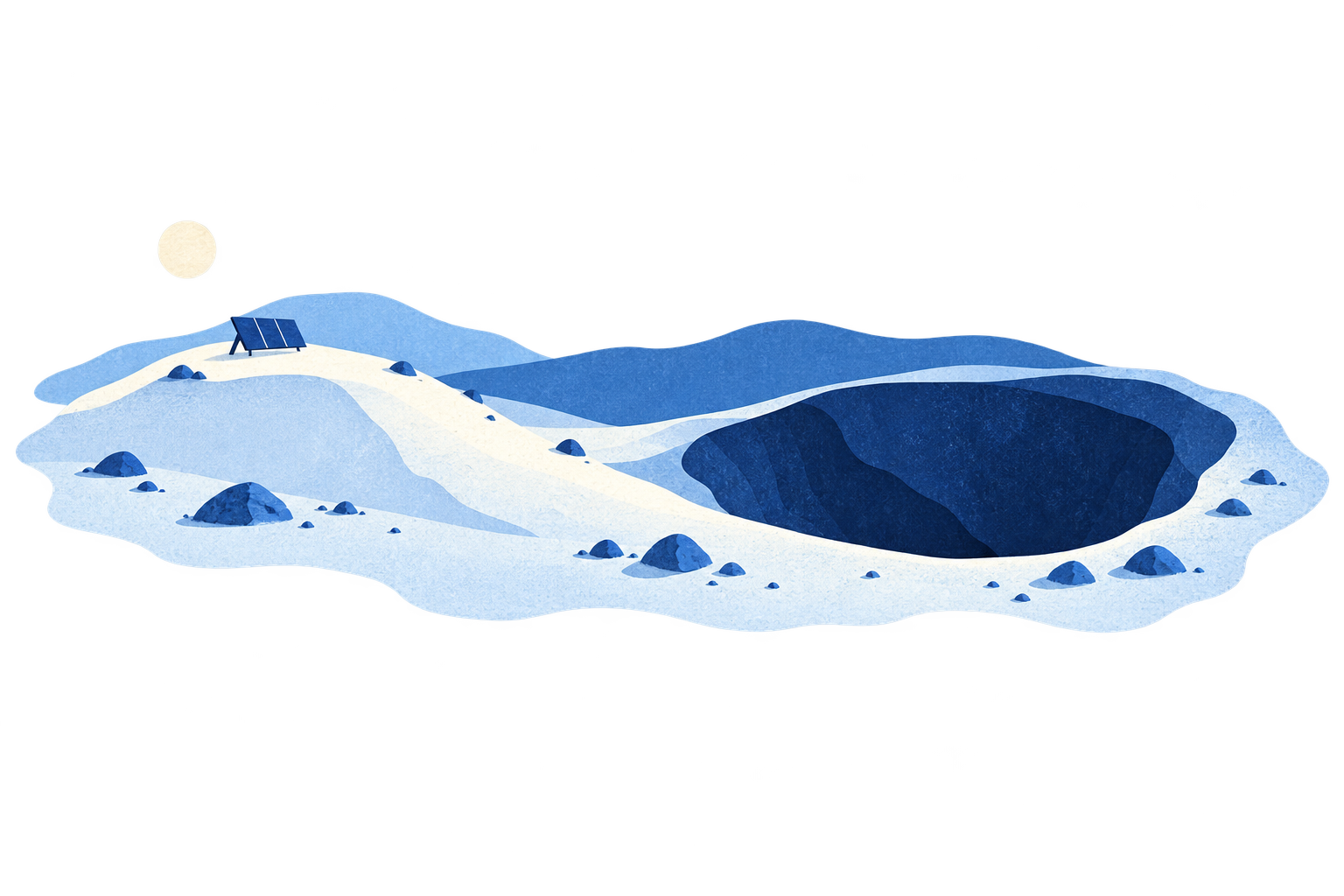
At the lunar south pole, light and shadow sit close together. Elevated terrain can offer useful solar illumination, while nearby permanently shadowed regions are targets for volatile prospecting. Reaching those resources also means dealing with difficult terrain, extreme cold and demanding surface operations.
The study connects those conditions to an early spaceport: where to land, how to construct the surface, and how to protect the systems that support repeated visits.
From terrain to requirements
Choose the site.
Design for what it asks of you.
A promising location is a starting point. Illumination, resource access and operational safety have to work together in a feasible layout.
Site selection
Why consider de Gerlache Rim 2?
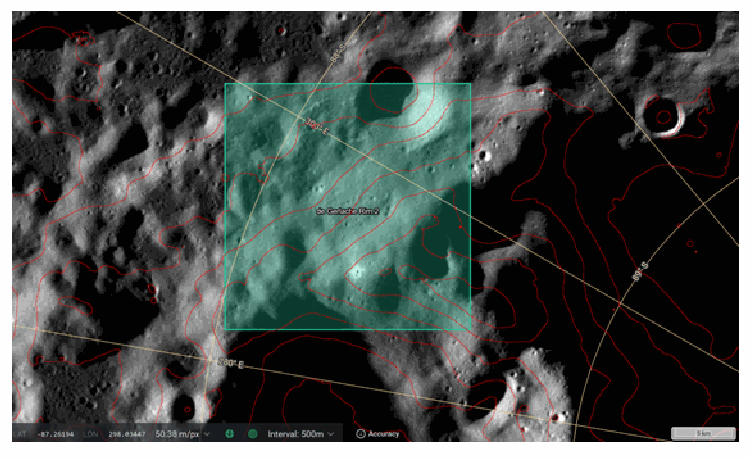
The team selected de Gerlache Rim 2 as a representative south-polar site for the case study. The report considers elevated terrain, illumination, proximity to shadowed regions and opportunities for communications with Earth.
The choice still needs local surveys. A regional indication of volatiles does not establish an accessible deposit at a particular construction site, and useful sunlight does not imply uninterrupted power throughout the year.
Report sourceSite rationale · pp. 9–11
Six conditions to consider together.
Light & power
Evaluate illumination through time, storage needs and periods without sunlight.
Resource access
Connect potential volatile deposits to prospecting, extraction and transport requirements.
Landing terrain
Consider slopes, surface roughness and ground suitable for construction.
Communications
Assess Earth visibility, local terrain masking and the role of relays.
Thermal conditions
Account for cold shadowed terrain and temperature changes during operations.
Surface logistics
Place routes, power systems and habitats around the constraints of the landing zone.
Landing infrastructure
Design around the dust.
Rocket exhaust can mobilise regolith and threaten nearby hardware. The report explores both crater-adapted pads and an engineered planar pad. Its approximately 100 m circular-pad concept combines regolith pavement with internal and external berms.
External berm
A surrounding barrier proposed to help manage plume and ejecta exposure. Its shape and behaviour require further modelling.
Internal berms
Four curved elements form part of the proposed plume-redirection concept. The sketch illustrates their arrangement.
Regolith pavement
Processed local material is proposed for a hardened surface. Durability, thermal loading and pavement erosion remain engineering questions.
A concept to evaluate. Berms and pavement do not establish that dust is contained or nearby equipment is safe. Plume–surface interactions and repeated operations need dedicated modelling and testing.
Report sourcePad concepts · pp. 19–21
From a candidate site to an operating surface.
- Survey the groundCharacterise terrain, regolith and the shallow subsurface before committing to a layout.
- Prepare the surfaceExcavate and grade the site, while assessing locally available construction material.
- Build the padDevelop regolith pavement and berms as elements of a dust-mitigation concept.
- Test & maintainValidate plume interactions, material durability and protection of nearby systems.
What came out
Environmental constraints become design drivers.
My contribution links lunar environmental knowledge to early infrastructure choices. The outcome is a set of considerations for siting, material use, surface preparation and protection of nearby systems, within the wider team architecture.
The SSP 2025 report also covers power, communications, logistics, governance and a longer-term vision. This page focuses on the site and environmental work I contributed to that study.
Study assumptions & original figures
Assumptions, not certified requirements
The short-term study assumes a small research base with a rotating crew. It considers separating the habitat from the landing area and using terrain for shielding. An approximate 500 m separation is a study assumption, not a validated safety distance.
Detailed surveys and testing would be needed before adopting the site, pad dimensions or layout. The longer-term scale described in the report is a scenario rather than a forecast.
Original report figures
The terrain map and original landing-pad rendering remain available alongside the source report.